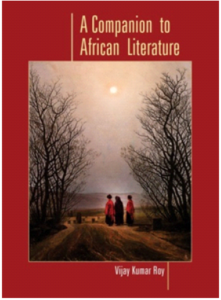
New Delhi: Paragon International Publishers, 2024, pp. xvi + 230, HB, Price: 995, $30, ISBN: 978-93-94964-67-9.
Reviewed by Amar Nath kumar
A lot of literature is being produced on Africa by the Africans as well as non–African scholars, each of them pointing towards the significance of the African societies, culture and traditions; and reemphasizing the indispensability of this great way of life with respect to the world culture today. And invariably the issues discussed and brought up in the texts range from the impact of colonization in these countries, the rampant corruption of the self governments, the afflictions inflicted due to vicious manacles of terrorism and to the irreparable damage to the flora and fauna of the once heavenly continent. So then what’s new and unique to this volume? A Companion to African Literature makes an honest attempt to address many of the contemporary issues pertaining to the major countries of the continent and elucidates these through serious studies on landmark texts written mostly by authors who truly belong to this soil. What more can we expect, when this anthology boasts of a scholarly, literary and humanistic study which has been analyzed and evaluated through the prismatic lens of critical, sociological, economic and cultural points of view. This compact edition on African studies will definitely help all literary scholars around the world.
The selection of articles very well depicts the meticulous planning and clear vision of the editor who has in the most unbiased manner given the deserving place to the relevant and pertinent issues shown amply by suitable representative texts. Very few editions can cater to the diverse interests and requirements of the reader, but as soon as you pick this volume, you are guaranteed to delve into all relevant issues and discourses on the African societies. And as if it were less, the anthology shelters all important writers produced by the continent through the years, and also endeavours to focus alike on prose, poetry and drama produced by its thinkers. Any anthology seems to be incomplete if the chapters don’t take a multi dimensional, multi-faceted and multi-layered approach because the study of the continent is vast and houses a panorama of complexities, conditions and concerns.
The contemporary writings of a country or continent are of immense importance because they are the ones which speak of the ongoing situation, the turmoil and turbulence of the air of that place. A Companion to African Literature exactly serves this cause on account of the kind of texts dealt in it; all of which have been produced in the last two decades within the continent. The discussions and discourses of post colonial disillusionment, corruption and terrorism have been adequately covered much like they find place in any random coffee house or a pub discussion today. Literature is a conglomerate which is formed by the continuous deposition of layers of new species of fiction and poetry to its edifice, and this is made possible by the study of humanity and society from varied perspectives by new authors and poets.This volume is indeed handy for any scholar who wants to have a fair view about the new breed of writers, verse creators and dramatists who are mushrooming in the nation states of Africa. In this league of writers, one cannot ignore Akachi Adimora, Akomaye Oko, Festus Iyayi, Tamure Ojaide, Athol Fugard, Niyi Osundare, Femi Osofisan and many others; and fortunately the editor as well as the contributors have diligently studied and considered the works of repute of most of these writers.
Today we speak of women’s emancipation, their rights, the women as leaders and decision makers and this has become a global narrative. The project of ‘Gynocriticism’ is honestly taken up in African Literature by female writers like Chimamanda Ngozi Adichie and quite a few chapters have been devoted to her works, which speak of leadership of Igbo women. Similarly, Nigeria today has become the epicentre of corruption, social complexities and even terrorism. A number of chapters take up the condition of the Nigerian society and the contradictions within the various ethnic groups which have resulted in civil war. Many countries in Africa are rife with the problems of prostitution, internal insecurities and the capitalist approach of the governments. The works of writers like Festus Iyayi, T. C. Nwosu taken up in this volume amply project these aspects of these societies. Interestingly, many writers in Africa today voice their concerns through poetry and detailed studies on the poetry of Tony Afejuku and Tanure Ojaide have been taken up in this anthology. The menace and hazard of environmental pollution is taking the disastrous form of a calamity and the entire globe is reeling and crumbling underneath this. Humanities takes it up in the form of eco-criticism, and many eco-critical and environmental pieces find place which in a subtle manner send the message of the crises in places like Ghana, Nigeria and Kenya.
A few chapters do deal with issues which seem to be repetitive, but needless to say, the book is a fine blend of the plethora of issues which Africa is braving presently. The concern today is to restore the lost identity and culture of Africa and the scholarly articles compel the readers to ponder on this. The true objective and aim of literature is to bring about a change, a reformation and a revival, and truly this edition succeeds in doing so to a considerable extent. Scholars and researchers are powerful agents to build up discourses within the academia and the society, which in turn brings about a change. Suggestively on these fronts, A Companion to African Literature is a must read for all students of Humanities and Social Sciences who want to have a scrutiny of the amazing continent, Africa.