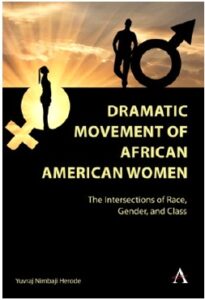
London and New York: Anthem Press, 2023, pp. x + 202, HB, Price: £80.00, $110, ISBN: 9781839988257.
Reviewed by Vijay Kumar Roy
“You can handcuff my wrists, and shackle my feet. You can bind me in
chains, throw me in your deepest darkest dungeon…but you can’t enslave
my thinking… for it is free like the wind.” – Jaye Swift, … But You Can’t
Enslave My Thinking …: A Novel of African American Intellect (2010)
Yuvraj Nimbaji Herode, PhD, is an assistant professor in the Department of English and Modern European Languages, University of Allahabad, India. His book Dramatic Movement of African American Women: The Intersections of Race, Gender, and Class is a research based exploration of African American women’s sufferings under the white patriarchy and African American social system. African American literature, as an independent branch, has substantial contribution in American literature, but it varies in terms of subject matter that it deals with. The strong point of the book is that it is an authentic delineation of experiences of formerly enslaved Africans in America. The book begins with a foreword by Professor Kashinath Ranveer in which he has commented on the roots of the commodification and subjugation of African American women in America and their consciousness of being African Americans, women, and servants as well as subsequent assertion of their existence as human beings through dramatic arts.
The author has discussed the subordination of African Americans in general and triple jeopardy, rooted in race, gender, and class of African American women in particular. In this book, he has judiciously developed his theory of intersectional oppression as,
In America, the white people were the masters, while the blacks were the
slaves. The white men were superior in the social hierarchy followed by
the white women. The black men were the slaves and the black women
were the slaves of the slaves. This is why; the black women are doubly
marginalized in the American society. At the same time, those who have
the means of material production at their command constitute the upper
class and those who lack the means of material production are at the
mercy of them. (7)
The slavery system forced the enslaved Africans to work on the plantations of the white masters in the South. They, being slaves due to economic and social backwardness, were the members of the servant class. The enslaved African women, deprived of human dignity, were forced to work either in the white houses or on the plantations. The author has focused on social, economic, political, cultural, and sexual exploitation of African Americans in general and African American women in particular. The book is the representative voice of the marginalized sections from across the world, because it speaks about racial hatred, oppression, discrimination, subjugation and objectification of women, pauperization of African Americans.
The book deals with the plays of three reigning African American women playwrights, namely Alice Childress, Lorraine Hansberry, and Suzan-Lori Parks who, through their plays, have voiced against social, economic, political and cultural exploitation of African Americans. These women playwrights used the theatre as a movement to dissent against the injustices meted out to them as black, female, and servant. The common topics of their plays were poverty, miscegenation, passing for whites, lynching, motherhood, African American history and identity.
The book focuses on the rise and development of the African American dramatic art that has been marked at the beginning of the nineteenth century. In fact, African American theatre has evolved through African folk culture having its roots in oral stage performances as well as in dance drama that the African Americans brought with them. It has gone through many ups and downs, still it has significantly contributed to American theatre. African American dramatists have destroyed the prejudices which were in existence pertaining to the history, culture, civilization and the life style of African Americans in general and African American women in particular.
The introductory chapter is divided into various segments to familiarize and structure the essential concepts in the book. It gives a general overview of African American people which makes us understand their tragic life, culture, and history. It discusses how the African Americans who had been silenced by racist white society for many centuries have broken their long silence by voicing against the hegemonic ideology of the whites through their plays. The elder generations of African American playwrights in nineteenth and early twentieth century have laid down the foundation of this protest. They have encouraged the younger generations of African American, especially African American women playwrights in later twentieth century to build their plays on that foundation. Alice Childress, Lorraine Hansberry, and Suzan-Lori Parks are the representatives of the younger generation who have continued the legacy of the dissent against racism, sexism, and classism through the dramatic movement.
The author has analysed the select plays of Alice Childress which delineate the triple deprivation and subjugation of African American women due to racism and also by the white and African American patriarchy. Florence is a commentary on the segregated race relations and stereotypical images of African American women having been treated as inferiors and others who have no potentials to establish themselves as professional actresses. Gold through the Trees recounted the pathetic events in the history of African Americans, especially African American women, from the beginning of European colonization in Africa, enslavement and transportation of Africans to American soil, systematic dehumanization and their struggle to regain full humanity.
The author has explored Trouble in Mind as a protest play dramatizing African American women who have no inspiring roles in the contemporary mainstream theatre. They are supposed to play the stereotypical roles in which they are forced, as helpless mothers, to surrender their children to white lynching mob. Wedding Band: A Love/Hate Story in Black and White focuses on the repercussions of anti-miscegenation laws which prohibit the marriage of an interracial couple, their suffering, and disastrous end of their relation. Wine in the Wilderness reveals the prejudices about African American women prevailing within African American community which is dominated by men, and women are subordinated and insignificant.
Lorraine Hansberry is another prominent African American woman playwright the author has delved into. Her play, A Raisin in the Sun, is about the discriminated race relations that exemplify through threatening by the whites when an African American family, living in ghetto and aspiring to advance materially without being materialistic, moves to the white colony. The book throws light on how, despite multiple conflicts of ideology among them, the African American women in the family are united to fight against the impending disaster. The Sign in Sidney Brustein’s Window focuses on the nuptial skirmish in which women have been treated as objects which fulfil men’s distorted sexual fantasy. However, the women became rebellious against their objectification. Les Blancs makes “a strong statement about race by highlighting the intersectional connection of colonialism, racism, sexism and patriarchy” (101). The Drinking Gourd divulges the debilitating effects of the institution of slavery in which African Americans live the life of servitude under the control of white masters. It dramatizes the troublesome journey of African Americans from slavery to freedom. Through What Use Are Flowers? Hansberry wants to inculcate the humanistic values – saving the only girl child, beauty, goodness, truth, honesty, and other creative and constructive arts – in the savage children to continue the human race.
Suzan-Lori Parks’ The America Play shows the suppressed history of African Americans which had been buried under the ground by the mainstream American historians by glorifying the history of their own. The African American historians, however, dug out their racial and cultural experiences to include in the mainstream history. Venus explores the inhuman act of using the body of African woman as a sexual object. In the Blood and Fucking A deal with African American women who have been socially ostracised by branding the A for adultery and abortionist. Thay are persecuted by ills in the society such as poverty, discrimination, sexual harassment, hypocrisy of black patriarchy and violence. Topdog/Underdog observes how the racism has robed the masculinity of African American men and turned them into effeminacy.
The book is a rallying cry of the African American women dramatists against the white brutality and animality. The author has accurately defined the term dramatic movement of African American women as “a consciousness of victimization that one is oppressed, because one is African American, female and poor” (169). The book is about the consciousness of those whose wrists were handcuffed; whose feet were shackled; who were bound in chains; who were thrown in the darkest dungeon; but whose thinking hasn’t been enslaved for it is free like the wind. Therefore,the book is a forerunner in African American literature that focuses on the African American theatre in general and African American women’s theatre in particular. All those interested in the study of the literature of the oppressed must read this book, because it will enable them to understand the literature of all the oppressed sections of society from across the world.