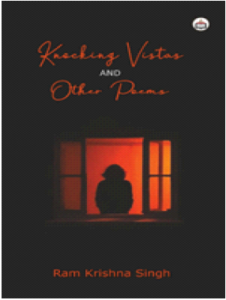
New Delhi: AuthorsPress, 2024, pp. 91, Price: 295, PB, ISBN: 978-93-6095-669-1.
Reviewed by Hariom Singh and Pramod Kumar Gond
Can a short poem or even a collection of short poems in its scope be as vast and diverse as a novel? A short poem, or even a poetry collection of moderate length, can definitely not rival a novel in terms of length but surely can accommodate as much complexity and diversity as fiction can represent or human life is believed to be full of. R. K. Singh, an internationally translated and recognised poet, through his latest offering, Knocking Vistas and Other Poems, makes an attempt, akin to a novel in its stupendousness, to understand and reimagine the essence of human existence, separating it from the methodised, scientific, and compartmentalised conceptions of reason and the near universal constructs of class and religion.
Consisting of 38 poetic pieces and an “Afterword,” R. K. Singh’s collection is a part of his ongoing attempt to impart new vigour to his lived experiences and observations on life by moulding them into poetry. The collection doesn’t apparently manifest any intentional design in the arrangement of poems, but, upon thoughtfully traversing through the pages of the book, one can discern with a little effort that some early poems, like “One More Poem,” “Love by Default,” etc., among the initial thirty-four poems of the collection, attempt to directly capture the thoughtful vibrations emanating from the microcosm of the poet’s own self. Gradually, the artistic vision of the poet ripens to concern itself with the forces and changes that are at work in the macrocosm, i.e. the outer world, beyond the personal, involving issues, ranging from national to international politics (“Consecration” and “War in Gaza”), violence and its after effects, and the preposterousness of politicians to perpetuate their vested interests, etc., that are plaguing the human society (“Politics of Deception”, “Let them Live”, and “Noises”), only to return to the poet’s atomic world again to reflect on the anxieties of one’s mundane existence with a diminished spirituality (“Feel Whole”) and a mind that constantly struggles with itself as well as the external world eluding peace: and few mute faces on the
and few mute faces on the road
won’t help me survive the race
to give life a meaning in
diversions of now and then. (“Glimpses of Truth”, lines 3-6)
A set of poems in the collection deal with the existential anxiety of the poet suffering in old age. These poems mostly stem from the poet’s reflection on the years gone by and/or, perhaps, from the inability to create something lasting. The poet writes:
in limited space
fear dominates deepening
my own mind that moves
through broken strains of
elegy and serenade. (“Shadow II”, 7-11)
The last four poems, greater in their sweep and thematically connected with the rest, appear unique in their technique and implications.
Certain themes and issues – for instance, the travails of creativity, a dulled imagination due to over-introspection, the eviscerated yet puzzling nature of lovemaking, and more – can be identified that are invariably present in every other poem in the collection. There are poems dealing with global events of violence and their repercussions: “War in Gaza,” “Politics of Deception,” “Dubious Gospels,” and so on. The poems like “Let them Live” combine the contemporaneity of violence with a scientific understanding of sex which has made it, in our times, merely an act of pleasure. These poems bring out the politically conscious nature of the poet, who can carefully map the bearings of the greater incidents on his private world. “New Slavery” is a pungent take on the class conflict and political oppressiveness of various ideological dispensations. Some others are overtly political satires and adopt a no-holds barred approach in criticising the communal agenda of the establishment with overt references to some cataclysmic events from Indian history. The mysterious and unperishable nature of evil, the poet finds overwhelming, and the hope for the survival of humanity appears only faint to him. Likewise, the sterile rhythm of humanity seems to cloud the poet’s ability to feel inspired to write enduring poems in “One More Poem”. The process of composition is painful and the poet suffers, but eventually it all results into a good poem. The poet feels that he is blessed with sanguine friends who keep him full of hope. Again in “Mystery,” life’s “unbloomed spring”, youth wasted in the pursuit of superficial pleasures, cannot produce a stir in the imagination of the poet (“Mystery” 6). Just as the season of autumn produces a stillness in the body, just so the creative juices of the poet too have run dry. Even a loss of love now doesn’t affect the emotions of the lovers.
Love and erotic longings are a central concern in the collection, especially characterising the opening poems. “Love by Default” takes a modern approach to understand a woman’s love “whose hunger is different each time she meets man”(10), underscoring how modern women in the company of their lovers grow oblivious of the difference between loving and love-making . Sex to Prof. Singh still remains an alluring mystery that even modern science has not understood; instead, it has made sex more mechanical, an act of incompleteness where beings bereft of knowledge are conceived. Some poems follow the stress pattern of the Haiku poems. “Love Hides” is a haiku sequence that presents a compelling intersection of love, sex, and mortality.
“Melting Elements,” in mysterious terms and relying heavily on sensual imagery, describes the relationship between a man and woman and the changing moods of both the partners. Their love is still in that phase where revelling in the surfeit of intercourse sums up one’s mortal existence. The sensual imagery, synaesthetic use of words, and the portrayal of the concupiscence of the lovers from their individual points of view produce before us a montage of the lives of the two. The cohabiting couple separates after getting intimate one more time, only to realise that eventually all comes to an end.
“Knocking Vistas” (I) is a series of Tankas that touch upon a variety of aspects of human existence that begin from the poet’s personal dilemmas to political problems of modern times, from emotions deeply and personally felt to a generalised perception of others’ opinions.
“Knocking Vistas” (II) is a string of thoughts cast in the form of Haikus where the poet weaves an eclectic mix of mythology, personal incidents and experiences, symbols that acquire new meanings, and science. The various thematic and structural elements impart a mysterious aura to each of the Haikus, one almost feels as if going through encoded messages stringed together without any regard for the spill over of thought from one to the next stanza. It requires some effort to decode the wider implications of each stanza.
The “Afterword,” penned by Kevin Marshall Chopson, a renowned poet and versatile artist, brings forth an appreciation of Prof. Singh’s poetic universe and his meticulous grasp over his craft, placing him alongside some of his personal favourite poets like Rilke and Mary Oliver.
In the end, it must be acknowledged that Prof. Singh has introduced new and experimental poetry on the Indian poetic scene. The collection, in some sense, is not meant for those readers who look for spontaneity and an abundance of emotions in poems, nor for those who like poems that are more focused in the treatment of their subject matter. These poems should be celebrated for their austerity of style, intellectual rigour, and sensitivity of perception. The readers are more likely to be left awe struck with the way in which an idea has been cast in the form of an amalgam of sound, rhythm, and metaphors. Each stanza/Haiku/Tanka opens several new vistas of thought when carefully reflected upon, leaving the readers wonderstruck and searching, with more earnestness, for that one particular strand of thought that connects or severs the next stanza from its previous one. Prof. Singh does not come across as an escapist, like W. B. Yeats, lost in his own mythopoeic world, or John Keats dwelling in his Hellenic world of eternal beauty. Instead, he embraces and undergoes every experience that comes his way to draw his own lessons from it.