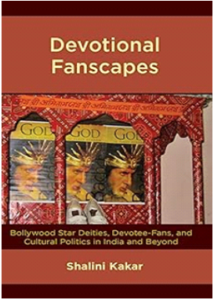
London: Lexington Books, 2023, pp. ix – 273, e-book, Price: 3941.58, ASIN: B0BRRQVJ28, ISBN: 978-1793646279.
Reviewed by Bitika Paul
In the recent era, the development of technology has resulted in boosting the ease and comfort of watching cinema. The public sphere has not been required in recent times as the spaces to watch movies are structured to provide personal spaces for the audiences. Similarly, the film artists are coming into the foreground and making a lasting impact on the audience’s psyche. The characters in the films have now entered the private sphere of humans, influencing the audience without any external barriers. On the other hand, India, having a culture of idol worshipping, derives the tradition of idolatry and uses that in creating star personalities. However, it is not just the audience; rather, the film as the medium itself too depicts the protagonists as larger than life, as Kakar herself points out:
It is this larger-than-life image of the film star that triggers his devotional adulation. It is not that the fans do not understand the difference between the reel and real persona of Amitabh, but the blurring of these two images is intentional, even orchestrated. (6)
A good number of books are being published describing the impact of Bollywood or Hindi movies on the audience. What makes Devotional Fanscapes different is its focus on the process of deification of the celebrities, thereby leading them to achieve the position of the personality cult. This book structurally demystifies the process involved in making celebrities the idealized image. It opens with a description of the specific fan clubs and religious sites created for the sake of celebrities in order to construct their identity. It then vividly discusses the production of the art as an object to establish the celebrities as the “Star Murtis” who are meant to be worshipped. Further, their space is not just limited to the spatiality; rather, the involvement of the fans or the Bhakts in the social activity foregrounds the celebrities’ presence as the lifesaver, hereby again emerging as the more revered figure. The author of the book does not just limit herself to depicting the presence of the fan culture in certain states of India, but it transcends the border by showing the global presence of the fan culture of Indian celebrities. The book mentions sociopolitical aspects related to fan culture development to provide readers with an idea of how a particular religious praxis transforms and stabilizes society.
The impact of the deified celebrities in increasing vote politics is described in the book as having influenced political power. It is not just the celebrities that have created such opportunities to enter into politics; their fans are also often offered some position in the political party for their capability to organize events in the social sphere. Idol worshipping has been noted to be an innovative way of capturing people’s attention and utilizing it to gain power. The in-depth psychology of the fans is studied here, in order to demystify the devotion of the fans. The relevance of the murti-puja society of India is well-captured in this text through the depiction of the activities of the fans becoming devotees.
The book describes the transformation of Amitabh Bachchan as the Hindu deity in Bachchandham, and also shows its influence in reference to the formation of the religion of Beyism for Beyonce fans. It has been demonstrated in a very detailed manner how the celebrities from the screen enter into the everyday lives of the people in real. It is due to the fans and their active participation in the social programmes in the name of the celebrities that the devotional aura surrounding the celebrities is enhanced.
Nowadays, fan clubs are prevalent throughout the world. Therefore, this text significantly highlights the politics dealing with it and the gateway of the celebrity in the everyday sphere of life. Celebrity culture plays an important role in contemporary society, so this book is helpful in demystifying the star deity in our culture. Further, the categorization of the fans according to their location, class and gender points out the fact that even the modernized religion of the celebrities too is not free from categorization. The most fascinating part of this book is that it provides visual images of the events that are performed by the fans. Specifically, in one case, the paintings are shown in the book by a fan, and that brings a noteworthy change in the artwork by infusing the author’s imagination through celebrity personality.
It has also been deliberately shown how, despite the creation of a new religion, traditional religious values have continued to exist. The book describes in most of the notable Indian fan clubs, the members indulge in spreading Hinduism through celebrities. While in some cases, the various religious roles of the celebrity are displayed, however, an inclination towards Hinduism practices is focused. For instance, initiatives for the unprivileged section of other religions are taken, but the power hierarchy is always maintained, elevating the position of the Hindus. Specifically, in the case of the temple of Amitabh Bachchan, the spread of Hinduism is blatantly visible when the fans perform “Hindu rites of puja (worship)”, augmented by the chanting of popular film songs or mantras appropriated from Hindu religious practices that are reoriented toward the star deity. For example, devotees recite Amitabh Chalisa and Madhuri Chalisa (“in place of Hanuman Chalisa, a devotional hymn dedicated to the Hindu god Hanuman”) and perform Amitabh Arati (“waving lamps and burning incense sticks in front of the star’s images”), Madhuri Puja, and so on, while ritualizing images of their cinematic deities. While Maqbool Fida Husain is described as being able to popularize his artworks, he managed to frame “Madhuri through the media of popular religiosity and cinema as an earthly and divine mother, revering her as a Hindu goddess” (149) along with Pappu Sardar. For the presence of nudity in his paintings, he suffered a lot in the hands of “right-wing Hindu organization”, but he did not cease his endeavour to establish Madhuri as the goddess. Therefore, the book has successfully pointed out the political purpose behind deifying celebrities and performing specific rituals, thereby extending the idol worshipping tradition.
In the final part of the book, the author interestingly crosses the border and shows how the transnational process of deifying the celebrities resulted in establishing them as the “God of our Gods” (178). The book points out the trend of getting “Rajnified” from India to the USA, specifically in the form of Murugan or superstar. His vogue is not just limited to achieving a celestial status, but he also goes on to achieve his own fan clubs, fanzines and even the computer programming language. In the case of Rajnikanth, he is not placed in the line of the pantheons; rather, he is regarded to be a one-man persona who derives powers from various pantheons and, at the same time, supersedes them. He is celebrated globally, and like Amitabh Bachchan or Madhuri Dixit, certain rituals are also practised only for him, which are again similar to that of Hindu rituals. In the political arena, his presence was felt very deeply as he was consistently depicted in the films and outside the film as the ideal hero who does not hanker after power. Transcending the national boundaries, the image of Rajnikanth appears in a new way by capturing a wide mass, which is due to his appearance of ritualized image in the urban spaces. For instance, in the USA, when the film Rajnikanth is released, the theatre space is transformed into a festive zone and the star murti is placed and revered. Hence, the celebration of Rajnikanth’s image in various locations and times led to uniting the Bakhtinian concept of space and time, thereby affirming his power of divinity.
This book has been capable of capturing the ongoing political sphere amidst daily life and entertainment. Further, the detailed description of the religious practices of the celebrities and defying them shows the amalgamation of politics within religion and the practised rituals of the people in their regular lifestyle. This book, thus, efficiently demystifies the devotional aspect of the star murtis.